№ 28
Chavela Vargas
La Paloma Negra · 1919–2012
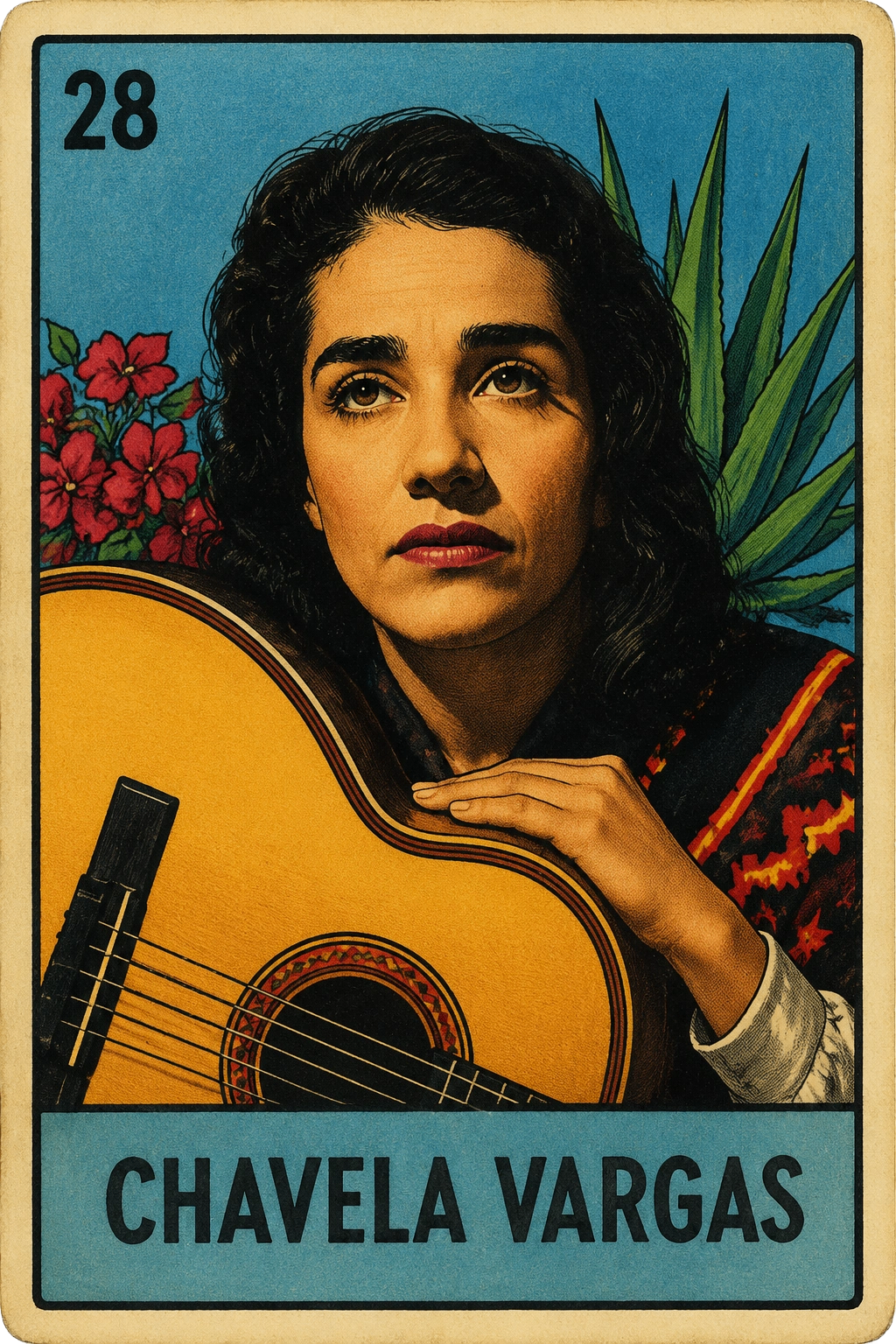
I couldn't stop listening to this song. The voice was — I don't even know how to say it — like a feeling of angelic, and you know what — it's a voice of a god. When she sings she just takes you to some other place where you can almost taste the tequila on your lips, smell the cigars, and the old varnish on the table you're sitting at. She destroys you and you wanna take a shot with her.
— Miko Malo
La Historia
Chavela Vargas was born in Costa Rica in 1919 and ran away to Mexico at fourteen. She didn't sing professionally until her thirties. By then she'd already cut her hair short, started wearing pants and ponchos when women didn't, and was carrying a pistol because the streets weren't safe for someone like her.
She sang rancheras — the most masculine genre in Mexican music, songs written by men, for men, about loving women. She refused to change a single pronoun. She sang te amo to women in front of audiences who knew exactly what she meant.
She had a long affair with Frida Kahlo. She moved through the world of Diego Rivera, García Lorca's poems, the Mexico City bohemia. Then alcohol took her. She lost everything. Disappeared for fifteen years.
She came back in her seventies. Pedro Almodóvar found her, fell in love with her, put her in his films. She sang at Carnegie Hall at 83. The Olympia in Paris. Bellas Artes in Mexico City.
She didn't officially come out until she was 81, in her autobiography. One sentence. She didn't have to. Everyone already knew. She had refused to lie about it for sixty years.
She died in 2012 at 93. Her last words were me voy con México — I'm going with Mexico.